


New Zealand
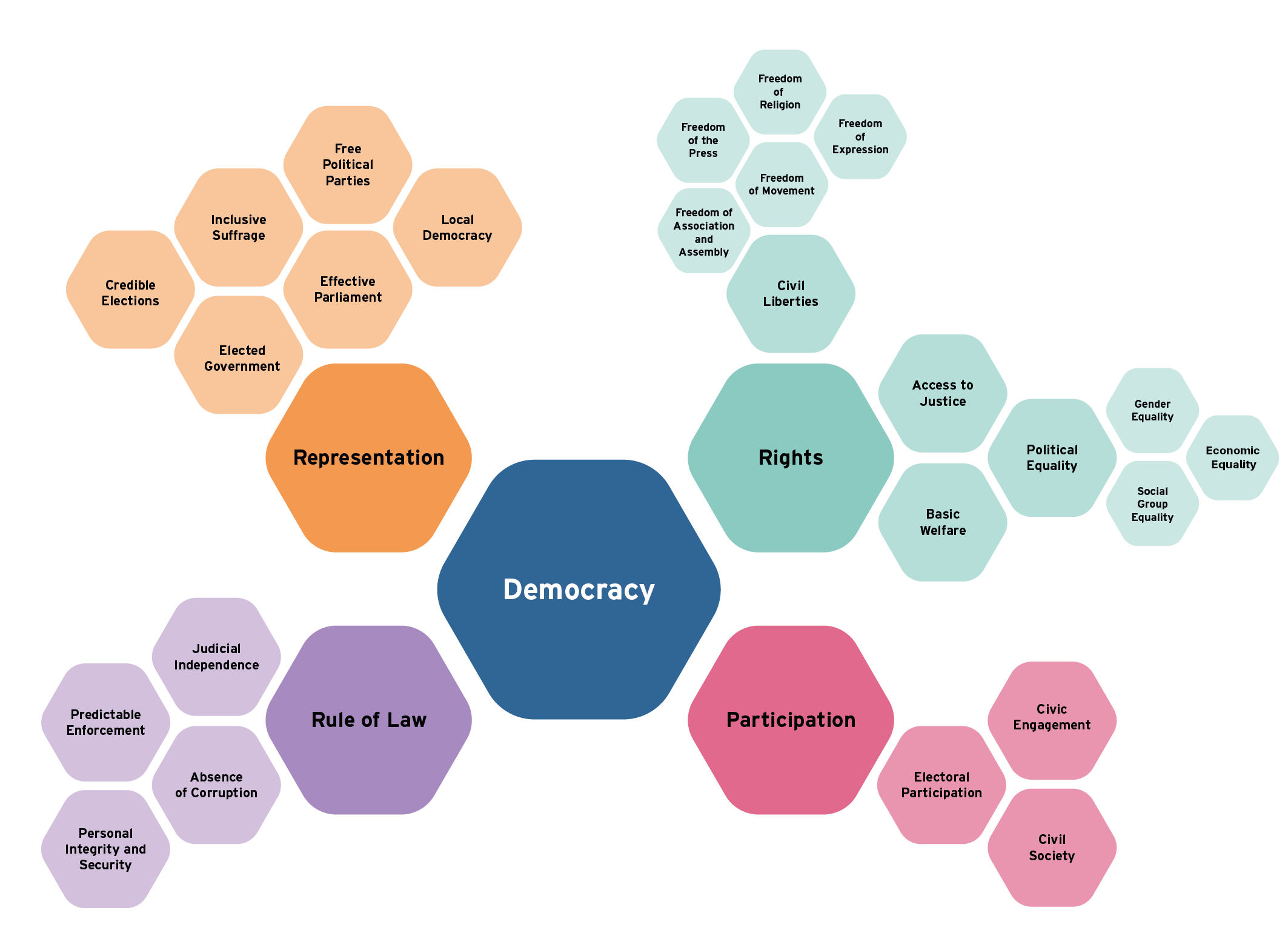
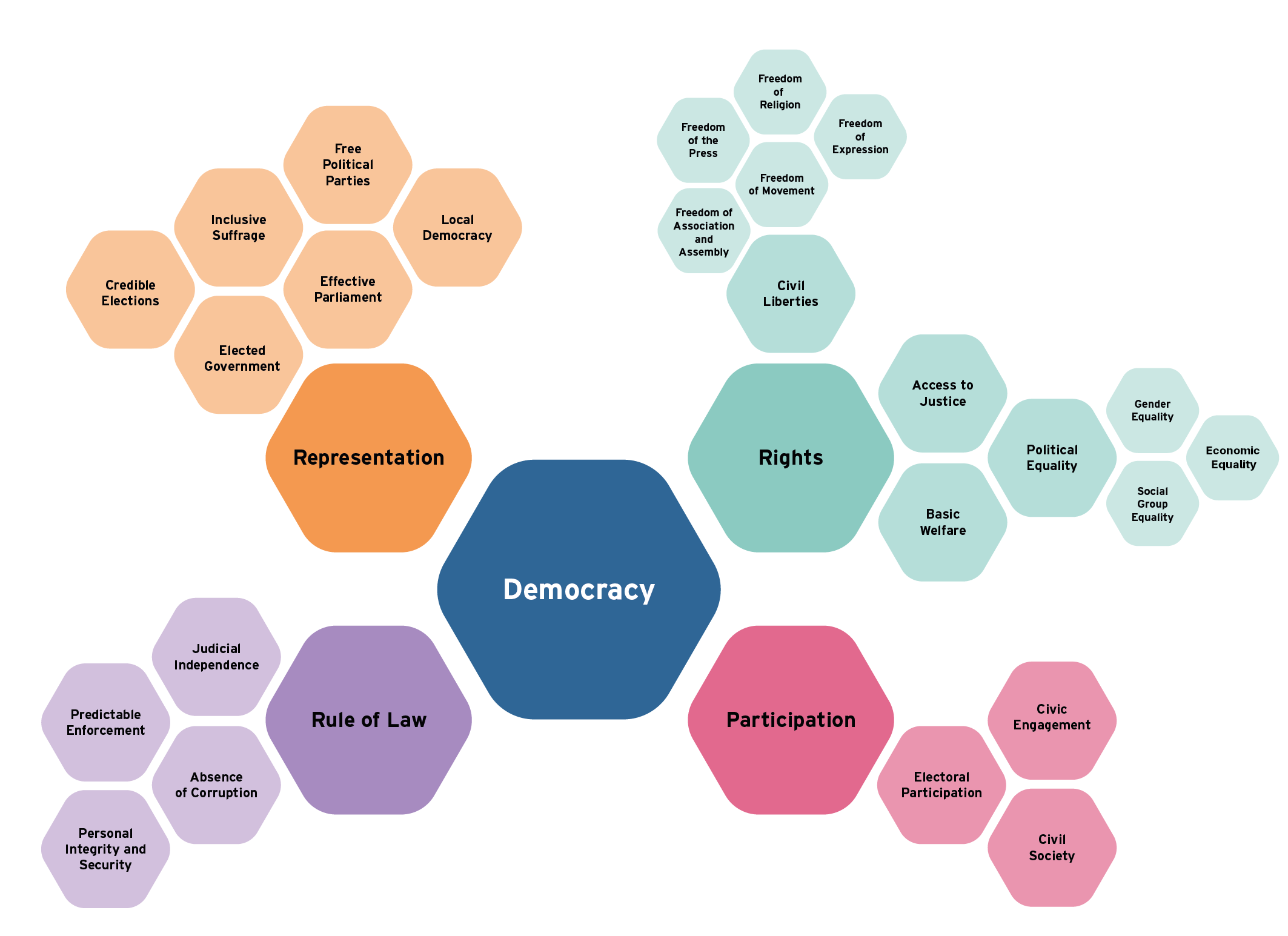
New Zealand exhibits high-range performance across three categories of the Global State of Democracy framework: Representation, Rights and Rule of Law. It performs in the mid-range with regard to Participation. With comparatively robust civil and political rights, it is among the world’s top 25 per cent of performers across the majority of factors. Over the last five years, the island country has experienced a decline in Freedom of Association and Assembly. The services industry makes the largest contribution to the economy, with manufacturing, professional, scientific and technical services taking the largest shares.
New Zealand is home to an ethnically-diverse population, with Europeans being the majority and the Māori and Asians and Pacific Islanders making up minority communities. The roots of the indigenous Māori community stem from waves of migration from Polynesia in the 14th century. European settlement occurred in the centuries thereafter. In the 1800s, larger numbers of British migrants arrived, culminating in the signing of the Treaty of Waitangi in 1840 – the founding document of modern New Zealand - which formed the political agreement between the British Crown and Māori. Although Māori customs and law (‘Tikanga’) have been recognized as part of the common law of the country, one of the key political fractures since the signing of the Treaty has been regarding Crown sovereignty and rangatiratanga (Māori authority over their own affairs); political debates around such power-sharing have been contentious. Historically low levels of Māori political representation have improved and the overall diversity of Parliament reached a peak after the 2023 elections.
Another key cleavage has pertained to socio-economic inequalities- the right to adequate housing and healthcare in particular. Emergency housing has become a prolonged arrangement for many, with the tightening of access policies leading to increasing instances of homelessness. Marginalized groups and minorities, including persons with disabilities, Māori and Pacific Islander communities, and low-income families, among others, have also struggled to access healthcare. In the Māori case, this was further complicated by the disestablishment of the Māori Health Authority - which in conjunction with a controversialproposed reinterpretation of the Treaty of Waitangi, drew significant public criticism and revealed deep fractures in the democratic consensus on Indigenous rights. Evidence also suggests that racism, discrimination and Islamophobia had become increasingly apparent in the years before the Christchurch terror attack in 2019.
Whilst New Zealand performs in the high-ranges on Gender Equality, progress on the indicator continues to be undermined by high rates of sexual and family violence in comparison with other wealthy and high-performing democracies. While the LGBTQIA+ community benefits from strong legal protections, challenges around higher rates of crime victimization and mental health disparities still persist.
Looking ahead, it will be important to watch Rights, in light of the seeming policy turn towards the gradual reinterpretation of indigenous rights. Relatedly, climate change, including sea-level rise and coastal erosion will have a disproportionate impact on the livelihoods of the Māori community in light of their dependency on primary industries. Meanwhile, false information online, a growing distrust in news, and a shrinking media industry may have implications for Media Integrity and Freedom of Expression in the long term.
Last Updated: June 2025
https://www.idea.int.developmentzone.co/democracytracker/
October 2025
New Zealand workers hold largest strike in four decades
More than 100,000 public employees, including teachers, doctors and nurses went on a one-day strike on 23 October, protesting low salaries, poor working conditions and underinvestment in public services. The strike was the largest since New Zealand’s only general strike in 1979, which included nearly 300,000 workers, and caps a year of growing labour activism in the country. While the country’s workforce was almost entirely unionized during the 1979 general strike, unionization is below 20 per cent today. Sectoral unions cited additional grounds for the strike, ranging from concerns over curriculum and exam procedures for teachers’ unions to short-staffing and a lack of support for training for doctors’ unions. Government representatives called the strike ’politically motivated’ and criticized the effect it had on schools’ and hospitals’ operations, which labour leaders and the political opposition rejected.
Sources: Reuters, Labor Notes, Radio New Zealand




May 2025
Parliament amends Pay Equity Act
Parliament passed on 7 May the Pay Equity Amendment Bill, which significantly narrows the scope for pay equity claims under the 2020 Pay Equity Act. The old Act allowed for legal challenges to rectify historical gender-based pay disparities within or between comparable occupations. The new rules restrict the occupations that can bring cases by requiring a higher proportion of those employed in a profession to be women, prioritizes comparisons within rather than between professions, and places additional burdens of evidence on claimants. The effects of these measures will become clearer in practice. The new law dismissed all claims currently under consideration, negatively impacting women who have launched legal action alleging discrimination. The bill was condemned by gender equity advocates, the opposition, and unions as making equity claims between professions de facto impossible. Business groups supported the changes but criticized the process as undermining public trust.
Sources: Radio New Zealand, DLA Piper, New Zealand Herald


March 2025
Parliament criminalizes wage theft
New Zealand’s parliament passed a law criminalizing wage theft on 13 March, meaning that victims will now be able to report suspected wage theft to the police for investigation. The law carries penalties of up to NZD 30,000 and one year in prison. Wage theft was previously considered a matter for civil courts, meaning that a worker who suspected her employer of wage theft needed to hire legal counsel and purse the case in civil courts. The bill’s sponsor, Camilla Belich of the opposition Labour Party, argued the civil process was lengthy, complicated, and dissuaded victims of wage theft from seeking recompense. The governing National Party opposed the bill on the grounds that too many criminal cases would “clog up the courts.”
Sources: Radio New Zealand, DLA Piper

Gang patch ban faces constitutional challenge

A lawyer for Mana-Apiti Brown filed a legal challenge in March in Wellington’s High Court to New Zealand’s “gang patch ban”, which allows for fines of up to NZD 5,000 or six-months’ imprisonment for wearing clothing with the insignia of one of 41 recognized gangs in public. The case alleges that the ban infringes on freedoms of expression and association, a legal argument which was also made in a report by Attorney-General Judith Collins on the ban when it was still under parliamentary consideration. Brown was convicted of wearing a hat with the name and logo of a gang in the Lower Hutt suburb of Naenae on 7 December 2024 and was discharged with a criminal conviction but without further penalty. Proponents of the patch ban say it allows police to proactively prevent gangs from intimidating community members. Between the law’s enactment on 21 November 2024 and 24 February 2025, police charged 337 individuals and seized 76 patches or articles of clothing.
Sources: Radio New Zealand (1), Radio New Zealand (2)
January 2025
Mount Taranaki (Taranaki Maunga) granted legal personhood
New Zealand’s parliament unanimously approved a law to grant legal personhood to the mountain Taranaki Maunga as part of the Treaty of Waitangi settlement process. In practice, this means the mountain and surrounding national park, Te Papa-Kura-o-Taranaki, will have the same rights and responsibilities of a legal person, and the lands themselves will be jointly managed by Crown representatives and the eight Maori iwi who historically inhabited the area. The decision comes after nine years of petitioning and negotiations between Taranaki iwi and the New Zealand government. The mountain is the third natural feature to be granted legal personhood in the country, and the status is intended to act as restitution for disposed Maori communities, preserve traditional use of the land, and conserve the native ecosystem.
Sources: Radio New Zealand, Jurist
See all event reports for this country
Global ranking per category of democratic performance in 2024

Basic Information

Human Rights Treaties
 State party
 Signatory
 No action
Performance by category over the last 6 months
 Representation
Rights
Rule of law
Representation
Rights
Rule of law
 Participation
Global State of Democracy Indices
Hover over the trend lines to see the exact data points across the years


Factors of Democratic Performance Over Time
Use the slider below to see how democratic performance has changed over time