

Albania
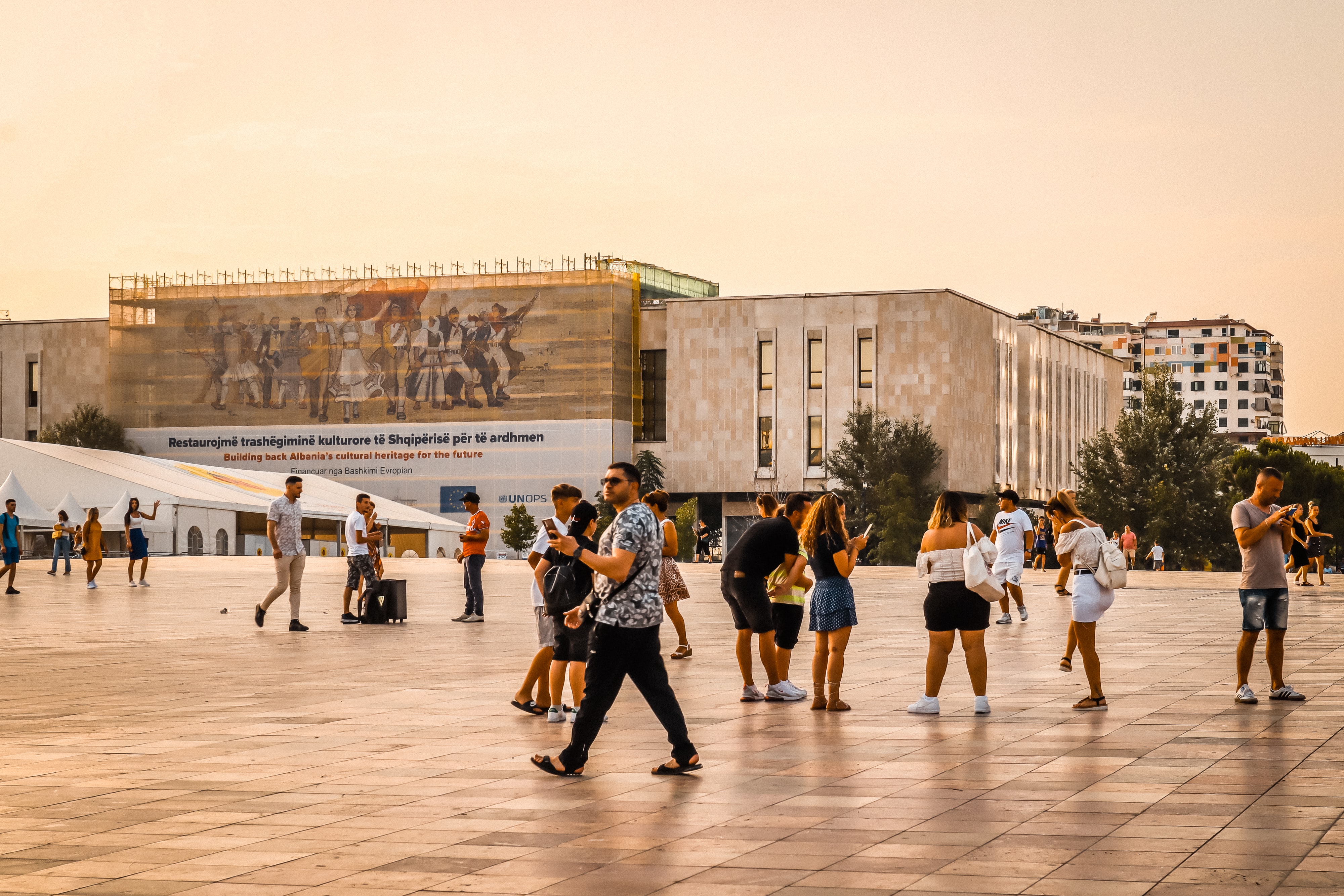
Albania exhibits mid-range performance across all categories of democracy in the Global State of Democracy Framework, scoring in the top 25 per cent globally for Freedom of Religion. Between 2019 and 2024, the country experienced a notable decline in Effective Parliament, driven by reduced legislative and opposition ability to scrutinize the executive. The country opened its third EU accession negotiation cluster in May 2025. The Albanian economy is mainly driven by services, construction, remittances, agriculture and a booming tourism sector.
Albania declared independence in 1912 after nearly five centuries of Ottoman rule. After World War II, the country experienced one of the most brutal communist regimes for forty years, becoming one of the most isolated and poorest countries in the world. Following the death of dictator Enver Hoxha, Albania transitioned to democracy after 1990. Its transition to a market economy has been characterised by corrupt privatisation efforts and state-led pyramid schemes.
The country has experienced a significant population decline since 1990 due to emigration lower birth rates, resulting in an ageing population. Albania, one of the most homogeneous countries in Europe, is known for religious tolerance and does not exhibit any major politically salient ethnic or religious cleavages. Instead, regional divisions are the major fault lines. Despite recent development, economic disparities persist between the less developed North and the more developed Central and Southern regions, as well as between rural and urban areas. While the Socialist Party (PS) has recently made electoral gains in northern Democratic Party (PD) strongholds, northern voters generally still support the PD, and southern voters the PS, reflecting regional loyalties and clientelist ties.
Politics tend to be highly personalised and polarized, fuelling partisan violence in society. Organised crime, money laundering and drug trafficking are widespread, often linked to political actors. This has weakened institutions and hindered inclusive economic development and equality. However, the establishment of Albania’s Special Courts against Corruption and Organised Crime (SPAK) has recently led to investigations, arrest warrants and the seizure of assets, including of high-level politicians.
Albania performs in the mid-range in Gender Equality, with its constitution prohibiting gender-based discrimination. The representation of women in politics has increased, exceeding the 30 per cent gender quota for parliamentary elections. Nevertheless, systemic issues, including gender-based violence and inequality in education, coupled with weaknesses in institutional support, remain. Albania made progress by becoming the third European country to ban conversion therapy in 2020, but the LGBTQIA+ community experience ongoing discrimination.
Looking ahead, it will be important to watch Representation, especially Effective Parliament and Free Political Parties, given the ruling PS’s unprecedented fourth mandate and large majority in Parliament, which raise risks of power concentration. Amid recent SPAK investigations into high-level corruption, it is equally important to watch Rule of Law, especially Absence of Corruption, Judicial Independence, and Predictable Enforcement. Additionally, Economic Equality should be watched, particularly in light of tourism growth and SPAK’s efforts to fight organised crime and corruption.
Last updated: June 2025
https://www.idea.int.developmentzone.co/democracytracker/
October 2025
Judicial assassination exposes security failures and public mistrust in judiciary
On 7 October, during a property dispute hearing at the Tirana Court of Appeals, the defendant in the case opened fire in the courtroom, killing the presiding judge and injuring two plaintiffs. According to reports, he acted knowing the case would not be decided in his favor. The assailant, who was carrying an illegal firearm, entered the building without being searched, even after triggering the metal detector. The security guard now faces charges of abuse of office. The tragedy sparked public debate and concerns about public trust and the state of the judiciary. The European Association of Judges noted that the Albanian judiciary is under strain due to the vetting process, with members of the judiciary facing public hostility and attacks. Both President Bajram Begaj and Prime Minister Edi Rama condemned the attack, with Rama publicly calling for harsher penalties on the illegal possession of firearms.
Sources: Euronews, The Guardian, RTSH, General Prosecution Office, European Association of Judges, Replika, Periskopi



August 2025
ECJ ruling further challenges Italy-Albania asylum-seekers detention deal

On 1 August, the EU Court of Justice (ECJ) ruled that while Italy (and other EU member states) may decide which countries are ‘safe’ for the return of asylum-seekers to their countries of origin, such designations must meet strict legal standards and be open to challenge with accessible evidence. The Court added that a country cannot be deemed ‘safe’ if it fails to provide adequate protection to its entire population. This comes after months of disputes between the Italian judiciary and the Italian government, as well as the transfer of migrants from Italy to costly, mostly inactive Italian-funded asylum centers in Albania, which have turned into repatriation centers. Italian Prime Minister Giorgia Meloni denounced the ruling, saying it weakens efforts to curb mass illegal immigration. The future of these centres remains unclear. Amnesty International described the ruling as a major setback for the Italy-Albania deal, which they argue outsources asylum processing at the expense of migrant and refugee rights.
Sources: International IDEA, Court of Justice of the European Union, Amnesty International, Al Jazeera, Euronews Albania, Heinrich-Böll-Stiftung


May 2025
Socialist Party wins election, securing PM Edi Rama’s fourth term

On 11 May, Albania held its parliamentary elections, in which the ruling Socialist Party (SP) won 52.2 per cent of the vote, securing Prime Minister Edi Rama an unprecedented fourth term. The SP will hold 83 of 140 seats in Parliament—just one short of the number needed for constitutional amendments. The opposition Coalition Democratic Party (DP-ASHM) came second with 34.3 per cent and 51 seats. Its leader, Sali Berisha, rejected the results, accusing the SP of vote-buying. Observers noted that the elections were competitive and professionally conducted but took place in a highly polarized environment and contestants did not enjoy a level playing field. Similar to the previous legislature, the proportion of women in Parliament will make up 35.0 per cent, exceeding the 30 per cent quota. Voter turnout stood at 42.8 per cent, down from 46.3 per cent in 2021.
Sources: Balkan Insight, Central Election Commission Albania, Politiko, Organization for Security and Co-operation in Europe
December 2024
Constitutional Court non-compliance persists despite the Venice Commission opinion
On 9 December, the Venice Commission issued an opinion, requested by the Assembly Speaker in September, on Parliament’s compliance with Constitutional Court decisions. It emphasized that compliance with the Court is essential to the rule of law, stating its decisions are binding. The opinion makes clear that “there can be no political discretion on whether or not to abide by and implement judgements” and that “effective compliance with these decisions should not be made conditional on a vote or a parliamentary majority.” The opinion also stated that Parliament is “not obliged to vote in a particular way.” The ruling majority defended parliamentary autonomy, while the opposition called for unconditional compliance. The Assembly Speaker said the opinion clarifies the sovereignty of the Parliament, refusing compliance with the Constitutional Court.
Sources: International IDEA, Venice Commission, Euronews, Shqiptarja (1), Shqiptarja (2), Balkan Insight

Prime Minister announces one-year TikTok ban
On 21 December, Prime Minister Edi Rama announced a one-year ban on TikTok, starting 1 January, following the murder of a 14-year-old boy by his peer over a TikTok argument and videos supporting the killing. Rama said the decision was also based on a survey of 65,000 parents, 90 per cent of whom requested TikTok's shutdown. The opposition accused Rama of attempting to stifle political campaigning ahead of the May elections. Critics argued that banning TikTok will not solve youth violence, and that children need education on navigating technology responsibly. Experts questioned the legal basis for the ban and warned of its implications for internet freedom, free expression, and media freedom. As of 29 January 2025, the ban had not been implemented. TikTok is one of the most popular platforms in Albania. According to ByteDance, as of early 2024, there were 1.53 million users over 18, and its reach extends to younger users despite a 13+ age requirement.
Sources: Shqiptarja, Balkan Insight, Reuters, Politico

See all event reports for this country
Global ranking per category of democratic performance in 2024

Basic Information

Human Rights Treaties
 State party
 Signatory
 No action
Performance by category over the last 6 months
Representation
Rights
Rule of law
 Participation
Global State of Democracy Indices
Hover over the trend lines to see the exact data points across the years


Factors of Democratic Performance Over Time
Use the slider below to see how democratic performance has changed over time